
OUR RISKS ASSESSMENTS PROGRAM OUTLINED
The 5 metrics that have potential to increase workers vulnerability to risk are seen as.
Country of operations and workers countries of origin.
The level and type of work they are employed in covering Skilled, Semi-skilled or Unskilled.
Category of employment, Permanent, Casual or Seasonal.
Established Industry issues including Gender Discrimination.
Abilities to address Supply Chain Risks.
Our most recent Country and Sector Risk Analysis as set out below provides us with a breakdown of risks across our updated Supply Chain sourcing program which currently includes China, Bangladesh and India (under review) where we work with our Supply Chain Partners and Worker Committees/Representatives to establish Root Causes for each identified Risk and work together across agreed mitigation and ongoing improvement programs. Identified and rated Risks shown in the presentations and our ongoing Risk assessment programs following are not solely based on Audit Data and include input and external information from external sources including:
· Ergon Associates reports including Global Risk Assessments, Country Risk Analysis and Grievance and Remedy programs. Note that Ergon Associates supported SEDEX re the development of Self Auditing Questionnaire model for service providers.
· The International Trade Union Confederation Global Rights index Global Rights Index - International Trade Union Confederation (ituc-csi.org)
US Department of Labour.
Amnesty International.
Human Rights watch.
Thomson Reuters Foundation.
Country Risk World Bank.
US Customs & Border Protection.
Transparency International
And others.
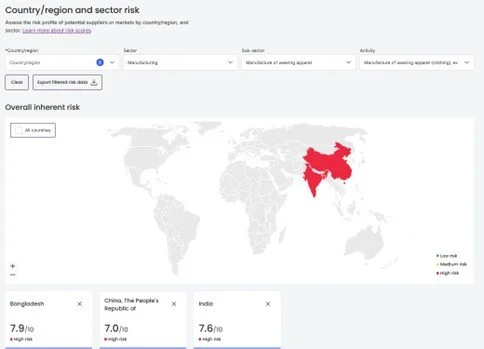
The Country/Regions and Sector Risk Analysis as below shows Overall Inherent Risk ratings for our various manufacturing sites for Bangladesh ,China and India compiled from SEDEX and various external sources which are listed above .Our Compliance and Sourcing Teams work together in extracting updated reports for our China and India ( under review ) and Bangladesh Supply Chains and share them with our Supply Chain Partner Factories and Worker Representative/Committees to establish Root Causes for identified Risk and work together across Ongoing Improvement and Mitigation Projects.
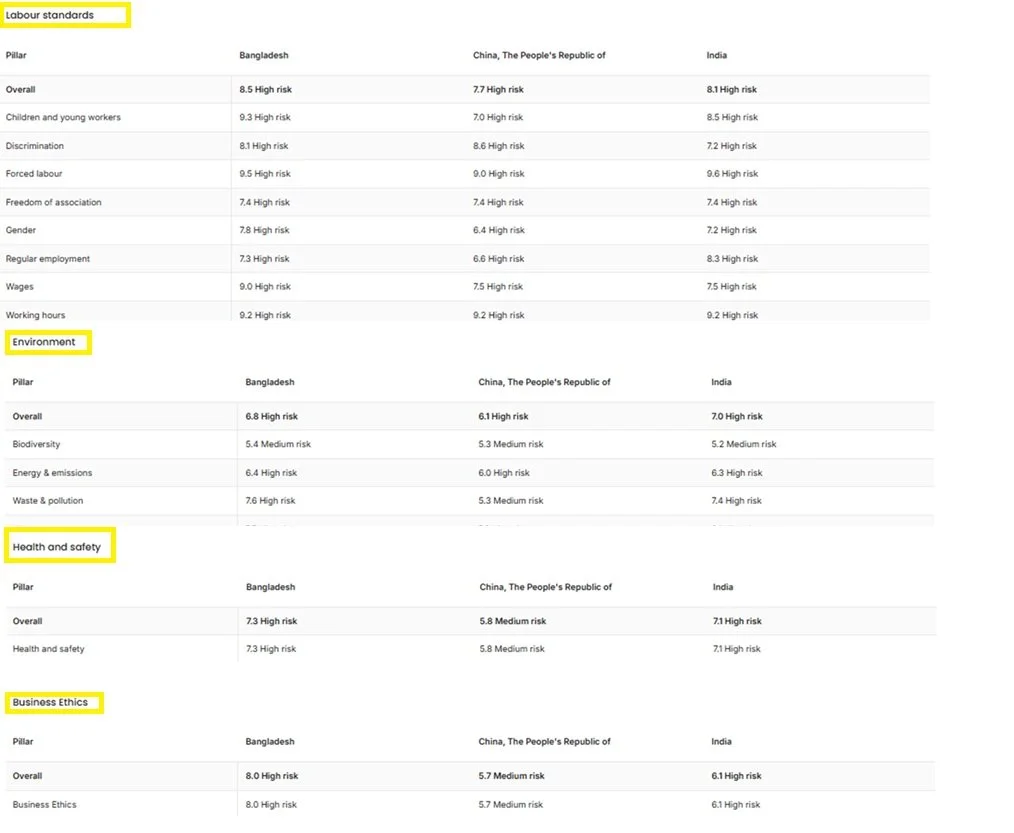
The Inherent Risks by Pillar reports show detailed RISK RATINGS for Bangladesh. China and India where Inherent Risks are detailed as below:
Product Risks as detailed below show Risk Ratings across Child Labour and Forced Labour for Bangladesh, China and India.

SALIENT RISKS: MITIGATION AND IMPROVEMENT PROGRAMS
SALIENT HUMAN RIGHTS RISKS
Freedom of association and effective worker voice mechanisms.
Health, safety and wellbeing.
Child labour – India and Bangladesh.
Low wages -
Forced labour = excessive working hours.
Gender and discrimination – India and Bangladesh.
References
Ergon Associates reports including Global Risk Assessments, Country Risk Analysis and Grievance and Remedy programs. Note that Ergon Associates supported SEDEX re the development of Self Auditing Questionnaire model for service providers.
The International Trade Union Confederation Global Rights index Global Rights Index - International Trade Union Confederation (ituc-csi.org)
Salient Human Rights Issues
The UNGP Guiding Principles on Business and Human rights together with the OECD Due Diligence Guidance for Responsible Business Conduct refers to the likelihood and severity of negative human rights impacts/risks to people connected to a business’s operations, Salient human rights risks exist where severe adverse impacts affect people within these operations.
Identifying our Salient Human Rights Issues
We have taken steps to identify human rights risks across our Supply Chain partners and our own operations utilizing various reports via our SEDEX programs as presented and where these were not solely based on Audit outcomes but included input and reference to a wide range of reports and findings from external sources as previously listed in our Risk Assessments Program outlined.
This process is based on both qualitative and quantitative information and reports from both SEDEX and the listed and other organizations and is further supported by our ongoing consultations and work with our Supply Chain Factory Management Worker Committee/Representatives and internally within our business operations where we have currently identified within our China based Supply Chain and more recently our recently onboarded Bangladesh and India (under review) Supplier factories the following current Salient Human Rights issues which are presented below together with our policies and procedures to address these.
|
Identified
Risks |
Projects
and Procedures to address risks |
Risks
to workers and where risks are most prevalent |
|
Occupational Health and Safety:
|
Continue roll out of SEDEX and Elevate eLearning modules
with review of ongoing improvements. Increase in unannounced audits and site
visits. |
Across all Tiers of Supply Chain where most vulnerable
include young workers, children, and female workers: Increased Risk of Injury
or death and loss of income directly affecting families. |
|
Excessive Working Hours linked to Forced Labour:
|
Overtime
Improvement Action Plan policy to be extended from China use to
include Bangladesh and India: End Qtr. 2, 2026. |
Across all Tiers of Supply Chain with migrant workers at
greatest risk: Breakdown in health, personal and family life standards. |
|
Wages and Social Security:
|
Social
Insurances action plan policy to be modified and extended from China
use to include Bangladesh and India: End Qtr. 2, 2026. |
Across all Tiers of Supply Chain with migrant workers,
female workers, temporary workers and low skilled workers most vulnerable:
Pressures to work longer hours and no adequate protection for access to
Social Security benefits directly affecting individuals and family life
standards. |
|
Discrimination including Gender:
|
Action consultation programs regarding an information
project with ETI teams in India and Bangladesh: End 2026. |
Most focus on female workers and migrant workers plus
minority groups. Isolation within and across Supply Chain workers; can lead
to lack of access to advancement within the business. Directly affecting
individual workers and family life standards. |
|
Freedom of Association and Collective Bargaining:
|
Extension of our Worker Representative/Committee Project
including Suggestion Box requirements, approved procedures and meeting
minutes. |
Presence across all Tiers of Supply Chain plus outsourcing
where vulnerable groups include worker representatives and migrant workers:
Subject to unacceptable working practices and requirements, poor wages and
dangerous working conditions. Directly affecting Individual worker and
Family life. |
|
Child Labour:
|
Action consultation regarding information project with ETI
teams in India and Bangladesh by end Qtr. 2, 2026. |
Current projects focus on Bangladesh and India linked to
poverty and access to education with focus on lower Tier levels including
farming (growing) and raw material supply: Damage to a child’s health and
development and access to education. |